A honest, detailed comparison of gas-powered and electric classic cars — across every metric that matters to owners who love their vehicles and want to drive them for decades to come.
It is the question every classic car owner eventually considers. You love the car. You love the way it looks, the memories attached to it, and the feeling of driving something with real character. But the engine is showing its age, parts are getting harder to find, and the practicality of actually using the car is diminishing year by year.
An EV conversion is not about erasing what makes your classic special. It is about preserving the car itself — the body, the interior, the presence, the soul — while replacing the one component that causes the most maintenance, the most frustration, and the most limitations on how often you can drive it. Our conversions are fully reversible, meaning the original drivetrain is stored and can be reinstalled if you ever choose to go back.
Below, we compare gas and electric drivetrains across the categories that matter most. The goal is not to convince you that one is universally better, but to give you the information you need to make the right decision for your car, your lifestyle, and your goals.
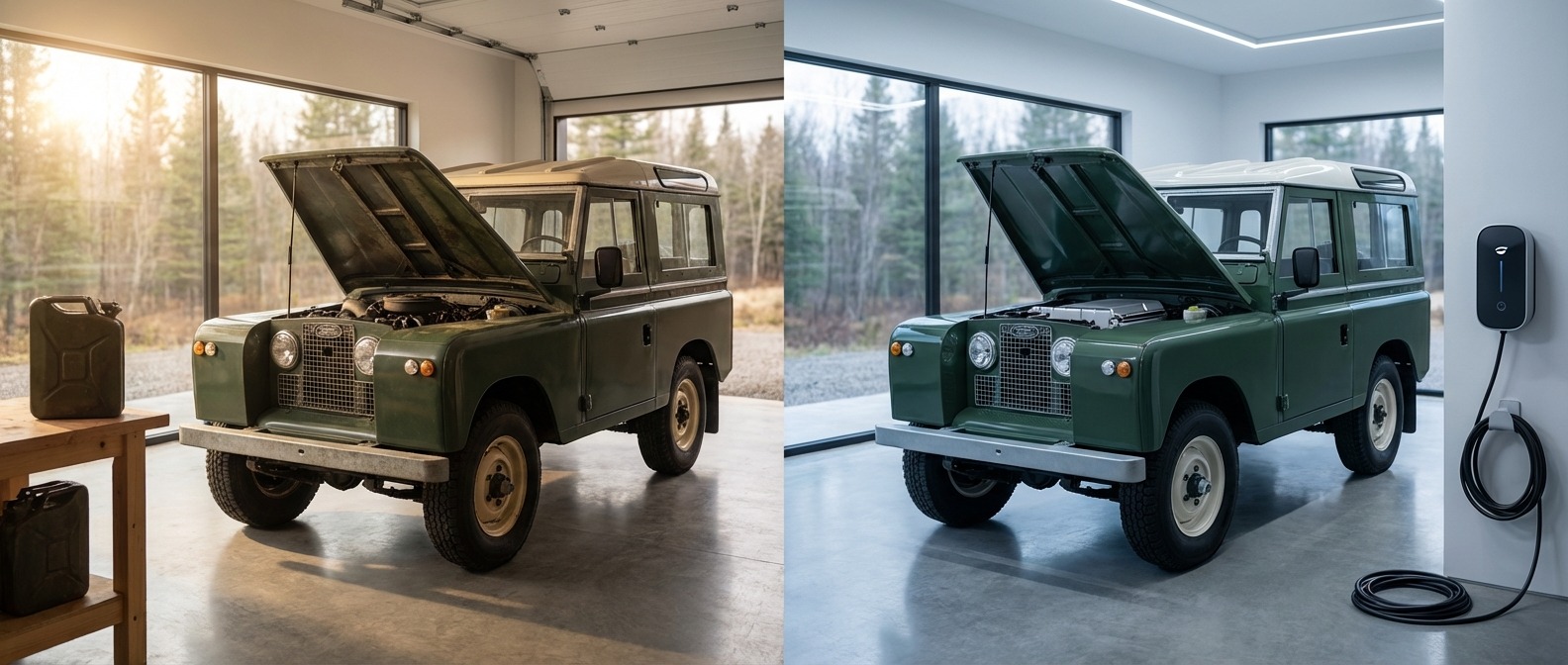
How do gas and electric classic cars compare across the metrics that matter most? Here is a straightforward breakdown based on our experience converting over 150 classic vehicles.
Specifications are based on typical Silent Classics conversions. Exact figures vary by vehicle, configuration, and driving conditions. See our pricing page for build-tier specifics, or explore our technology for component details.
The debate between gas and electric misses a fundamental point: the best version of your classic car is not about the drivetrain. It is about the car itself — its lines, its history, its character, the way it makes you feel when you see it in the driveway. The drivetrain is the means; the car is the end.
Our philosophy at Silent Classics is simple: preserve the classic, upgrade the drivetrain. We keep every exterior detail, every interior surface, every piece of trim that defines your car's identity. We remove only the aging combustion components — the parts that leak, break, pollute, and prevent you from driving the car as often as you would like — and replace them with a modern electric powertrain engineered specifically for your vehicle.
The result is a car that looks exactly as it always did, but drives better than it ever has. Faster acceleration. Smoother power delivery. Better handling from the lower center of gravity. Dramatically reduced maintenance. And the ability to drive it daily, in any weather, without worrying about reliability or running costs.
And because every Silent Classics conversion is fully reversible, you are not making a permanent choice. The original engine, transmission, and fuel system are carefully cataloged and stored. If you ever want the combustion experience back, we can reinstall it. You get to enjoy the electric present while keeping the combustion past safely preserved.
Learn about our meticulous process
The comparison table gives you the overview. Here is the context behind the numbers — the practical realities of living with each drivetrain type in a classic car.
A classic car's combustion engine is a complex system of hundreds of moving parts, all of which wear out over time. Gaskets harden and leak. Carburetors fall out of tune. Timing chains stretch. Exhaust systems rust through. Even a well-maintained classic requires regular attention that adds up to significant time and cost. An electric motor, by contrast, has a single moving part: the rotor. There are no fluids to change, no filters to replace, no timing to adjust. The reduction in maintenance is not incremental — it is transformational. Learn more about the components we use and their longevity.
Many classic car owners worry that going electric means losing performance. The reality is the opposite. Electric motors deliver their full torque from a dead stop — something no combustion engine can do. A first-gen Mustang with its original 289 V8 produces around 200 hp and takes roughly 9 seconds to reach 60 mph. The same Mustang with an electric drivetrain can produce 400 hp and reach 60 in under 4 seconds, with the smoothest acceleration you have ever experienced. The driving experience is not diminished; it is elevated.
An EV conversion requires a meaningful upfront investment — our pricing starts around $25,000 and scales with the scope of the build. But the ownership economics change dramatically afterward. No fuel costs beyond home electricity. No oil changes. No exhaust work. No carburetor rebuilds. Over a five-year period, the total cost of ownership of an electric classic is often lower than keeping the original engine running, especially for vehicles that are driven regularly.
We would be dishonest if we did not address the elephant in the room. For many classic car owners, the sound of the engine is a significant part of the experience. The rumble of a V8 at idle, the bark of a straight-six under acceleration — these are visceral, emotional elements that an electric motor does not replicate.
We believe in being transparent about this: if the sound of the engine is the primary reason you own your classic car, an EV conversion may not be the right choice for you. And that is perfectly fine.
However, we have found that the vast majority of our clients — even those who initially had reservations about losing the exhaust note — come to deeply appreciate the silence. There is a different kind of drama in the instant, silent surge of an electric launch. There is a new kind of pleasure in driving a Land Rover through the countryside hearing nothing but the world around you. And there is a practical advantage in being able to start your classic truck at 6 AM without waking the neighborhood.
For owners who want both experiences, we offer optional sound simulation systems that can be toggled on and off. But most clients who install them end up leaving them off after the first month. The silence grows on you.

An EV conversion is not right for every classic car or every owner. Here is how to think about whether it is right for yours.
Still weighing your options? Explore these resources to learn more:
The best way to understand the gas-to-electric transformation is to see it on a vehicle like yours. Each model page includes detailed specifications, generation guides, and examples from our completed builds.
200–320 mi range, 300–500 hp. America's pony car, reimagined with silent, instant torque.
Mustang guide180–280 mi range, 250–400 hp. Silent off-road torque for the world's most capable classic.
Land Rover guide150–250 mi range, 300–450 hp. Massive towing torque for the classic working truck.
Pickup truck guideWhether you have already decided or still have questions, we are here to help. Tell us about your classic and we will walk you through exactly what an electric conversion would look like for your specific vehicle.
Not ready yet? Browse our completed builds for real-world examples, explore our conversion services, or learn about our process from consultation to delivery.